
Guide
How much is my coin worth? Six steps to a realistic answer
An old coin from a drawer, an inherited collection, an odd coin from a trip: you can judge most of them yourself if you go through the same steps every time. This is how I do it.
The short answer
A coin's value comes down to four things: exactly which coin it is (country, date, mint mark, variety), its grade, how many collectors want it and, for silver and gold, its metal value. Check those, compare prices that were actually paid, and you get a realistic range instead of a guess.
1. Identify the coin exactly
Before you look up prices, you need the precise name: country or issuer, denomination, date, mint mark and design. Tiny differences matter. A German 50 Pfennig dated 1950 with the inscription “Bank deutscher Länder” has an official mintage of 30,000. The same date with “Bundesrepublik Deutschland” was struck more than 66 million times.
Mint marks are small letters near the date. On German coins, for example, A stands for Berlin, D for Munich, F for Stuttgart, G for Karlsruhe and J for Hamburg. One design can have very different mintages per mint: the 1958 German 5 Mark silver eagle had 600,000 pieces from Stuttgart (F) but only 60,000 from Hamburg (J).
2. Grade it honestly
Condition is the biggest lever on price. Most of the world uses the 70 point Sheldon scale or the words behind it:
| Grade | Sheldon number | What it means |
|---|---|---|
| Good (G) | 4 to 6 | Heavily worn, outlines visible |
| Fine (F) | 12 to 15 | Even wear, main details visible |
| Very Fine (VF) | 20 to 35 | Clear wear, details still sharp |
| Extremely Fine (EF, XF) | 40 to 45 | Light wear on the high points |
| About Uncirculated (AU) | 50 to 58 | Traces of wear only |
| Mint State (MS) | 60 to 70 | No wear from circulation |
How much grade matters: for the German 5 Mark 1958 J, silberadler.info quotes about €350 for a genuine coin in Very Fine (a 2012 figure) and €4,500 in mint state. Same coin, more than ten times the price.
Do not clean your coins. Cleaning permanently changes the surface. NGC does not give improperly cleaned coins a normal numeric grade.
3. Look up mintage and variety
With the exact name, look the coin up in a catalog. The free online catalog Numista lists mintages per year and mint for many coins, plus recent auction results. A small mintage alone does not make a coin expensive. What counts is how many survive in good condition and how many collectors want one.
4. Work out the metal value
Silver and gold coins have a floor: the value of the metal inside.
Fine weight = weight × fineness
Metal value = fine weight × price per gram
Example, German 5 Mark silver eagle: 11.2 g × 0.625 = 7 g of fine silver. 7 g × €1.70 = €11.90. German dealers sold common dates for €12.02 and up that day, barely above melt. Rare dates sell for many times more.
Silver price: €52.96 per troy ounce, about €1.70 per gram (gold.de, 13 Oct 2026, 20:34).
5. Compare prices that were actually paid
- Auction results. At Künker, a lot of three German 5 Reichsmark “oak tree” coins in Very Fine to Extremely Fine hammered at €210 against a €75 estimate. Numista collects results like these per date, for example $439.20 for a 1950 G 50 Pfennig in NGC MS66 at Heritage on 26 May 2026.
- Sold listings on marketplaces, not current asking prices.
- Dealer prices as a ceiling. A dealer buying from you pays less than they charge.
Asking prices can be wild. The 2009 2 euro coin with the stick figure has been offered online for €8,500, yet it is the common issue for ten years of Economic and Monetary Union that every euro country of the time put out.
6. Get valuable coins checked
If a coin looks like it is worth more than a few hundred euros or dollars, get a second opinion from a coin dealer or auction house, and for high values a grading service such as NGC or PCGS. Sought after coins get faked: silberadler.info calls the 1958 J 5 Mark the most counterfeited coin in Germany.
Where the app helps
Reading German? There are detailed German guides to the 5 Mark silver eagle and to Reichsmark coins and their silver content.
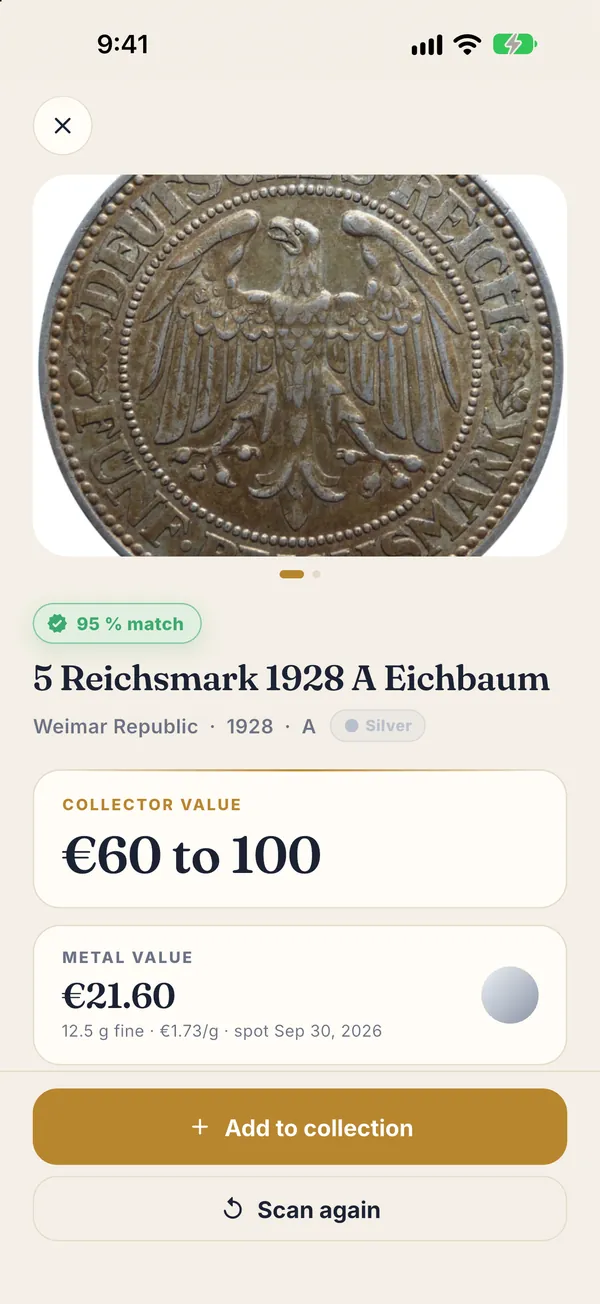
Coin Value takes care of steps 1 and 4. It identifies the coin from photos of both sides, shows date, mint mark, catalog number, composition and mintage, estimates a collector value range and calculates the metal value of silver and gold coins from the current price. Checking grade and authenticity in hand is still up to you or a dealer.
Frequently asked questions
How can I find out if my coin is valuable?
Is there a free way to check what my coin is worth?
Should I clean an old coin before selling it?
What will a dealer pay for my coins?
Sources
All sources accessed on 13 October 2026.
- Numista: 50 Pfennig Bank deutscher Länder 1949 to 1950 (mintages, auction results)
- CoinVarieties: Germany 1950-G 50 pfennig
- Numista: 5 Deutsche Mark 1951 to 1974 (mintages)
- Wikipedia: Sheldon coin grading scale
- silberadler.info: 5 DM 1958 J
- NGC: Why Cleaned Coins Can't Be Uncleaned
- gold.de: 5 DM silver eagle, dealer prices and silver price (13 Oct 2026)
- Künker: 5 Reichsmark 1928 A, 1932 A and E (archive lot)
- echo24.de: asking price for the 2009 stick figure coin
- ECB: 2 euro commemorative coins 2009, common issue for 10 years of EMU